
PRISM: Peter Brook-When Colour Changes the Way We See
28 August 2026
Written by Xin Ji
When I first looked at Peter Brook’s Byzantium sky and Razzmic Cinnabar, I found that they were very alike in composition. Both paintings are divided horizontally into two broad fields of colour, crossed by a row of narrow vertical lines. Their structures are orderly and controlled, almost as though the same visual formula had been repeated. Despite this shared composition, the two works create remarkably different experiences through the use of colour.
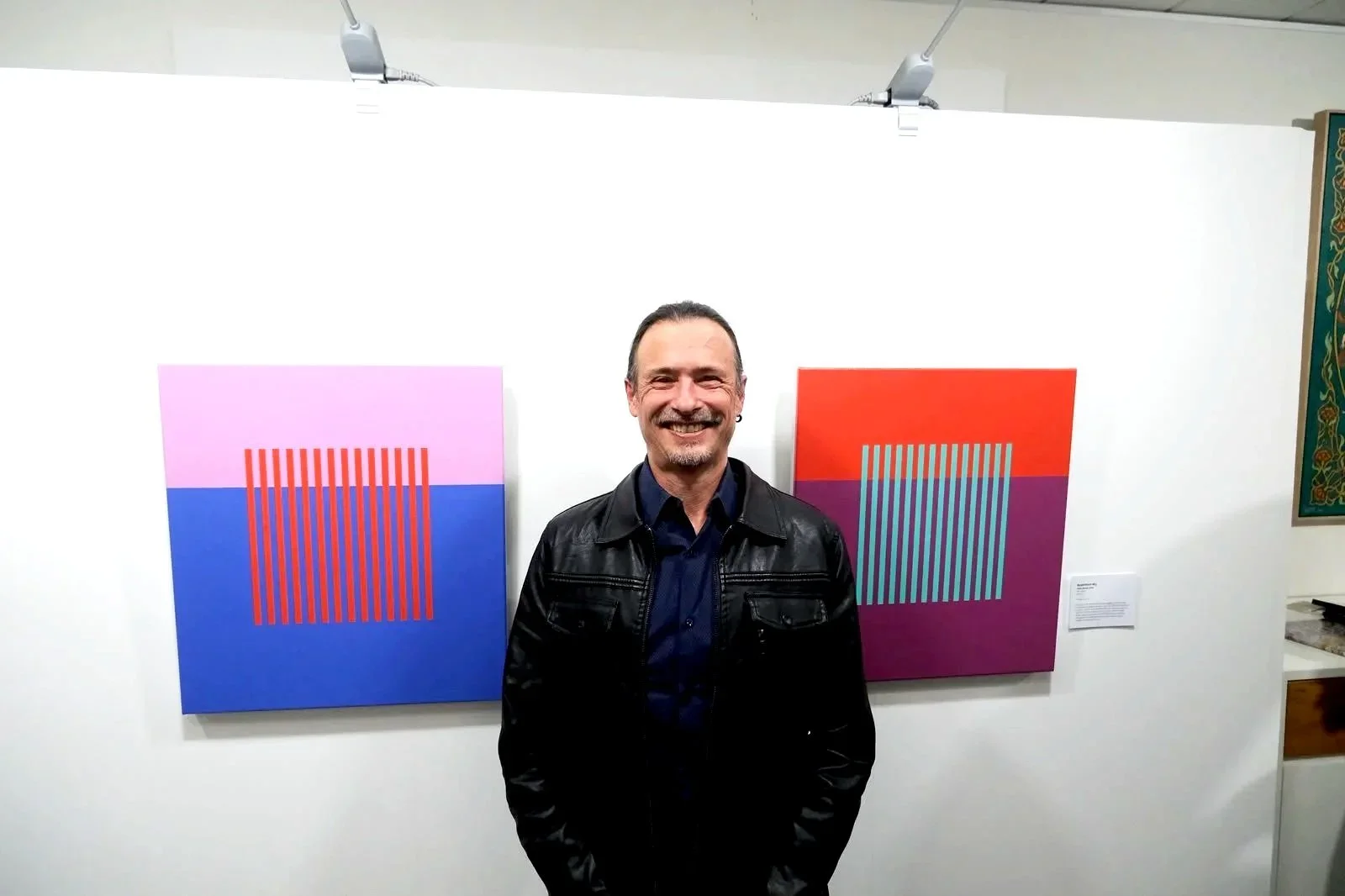
Peter Brook with his paintings Byzantium sky and Razzmic Cinnabar at the PRISM exhibition opening night at ROMULUS.
This difference made me think about the concept behind PRISM. A prism reveals the many colours contained within a single beam of light. In Brook’s paintings, a familiar arrangement also opens into multiple ways of seeing. Colour does not simply decorate the composition; it changes its atmosphere, spatial depth and meaning.
In Byzantium sky, a warm red-orange field meets a deep violet-purple, while pale turquoise lines extend across the boundary between them. The colours feel bold and energetic. To me, the horizontal division resembles a horizon against a coastal sunset sky. Razzmic Cinnabar uses almost the same structure but creates a different visual experience. A soft pink upper field meets a saturated blue below, interrupted by vivid red-orange lines. To me, this painting feels brighter, sharper and more urban. The repeated lines in both paintings remind me of barcodes, structures, or light falling across a surface. Nothing is represented literally, leaving these visual relationships open to interpretation.
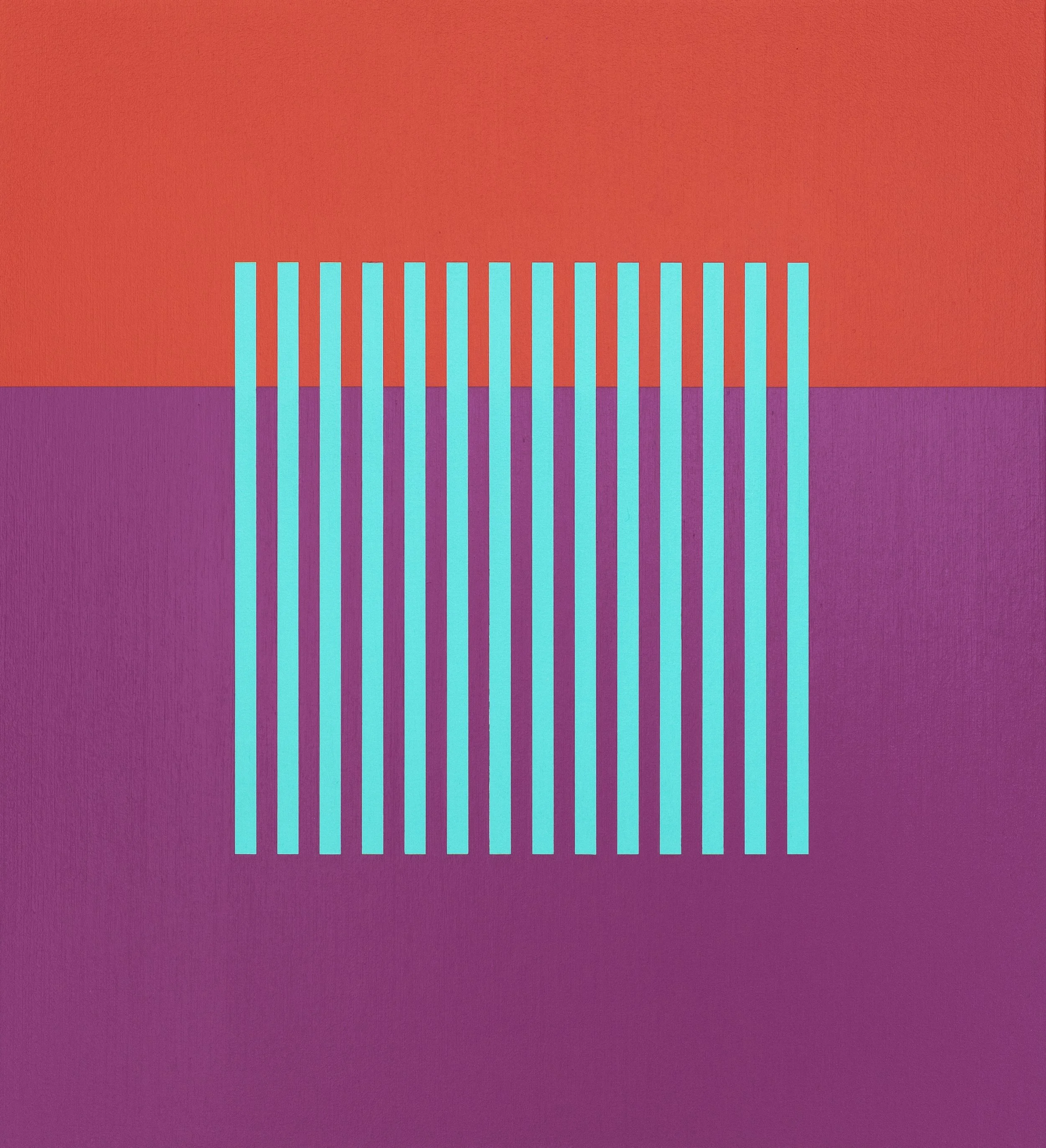
Peter Brook, Byzantium sky, 56 x 51cm, Acrylic on Linen, 2024, SOLD
These experiences become clearer through Brook’s description of his works. Byzantium sky explores the responsive behaviour and perceptual force of colour, drawing from both the artificial glow of backlit screens and observations of light falling on patterns and surfaces in the built environment. I find this especially interesting because these two sources of inspiration are so familiar in everyday life. We constantly move between digital screens and physical spaces, often without thinking about how differently light and colour behave within them. Brook brings these experiences together, turning them into something less familiar and more difficult to define.
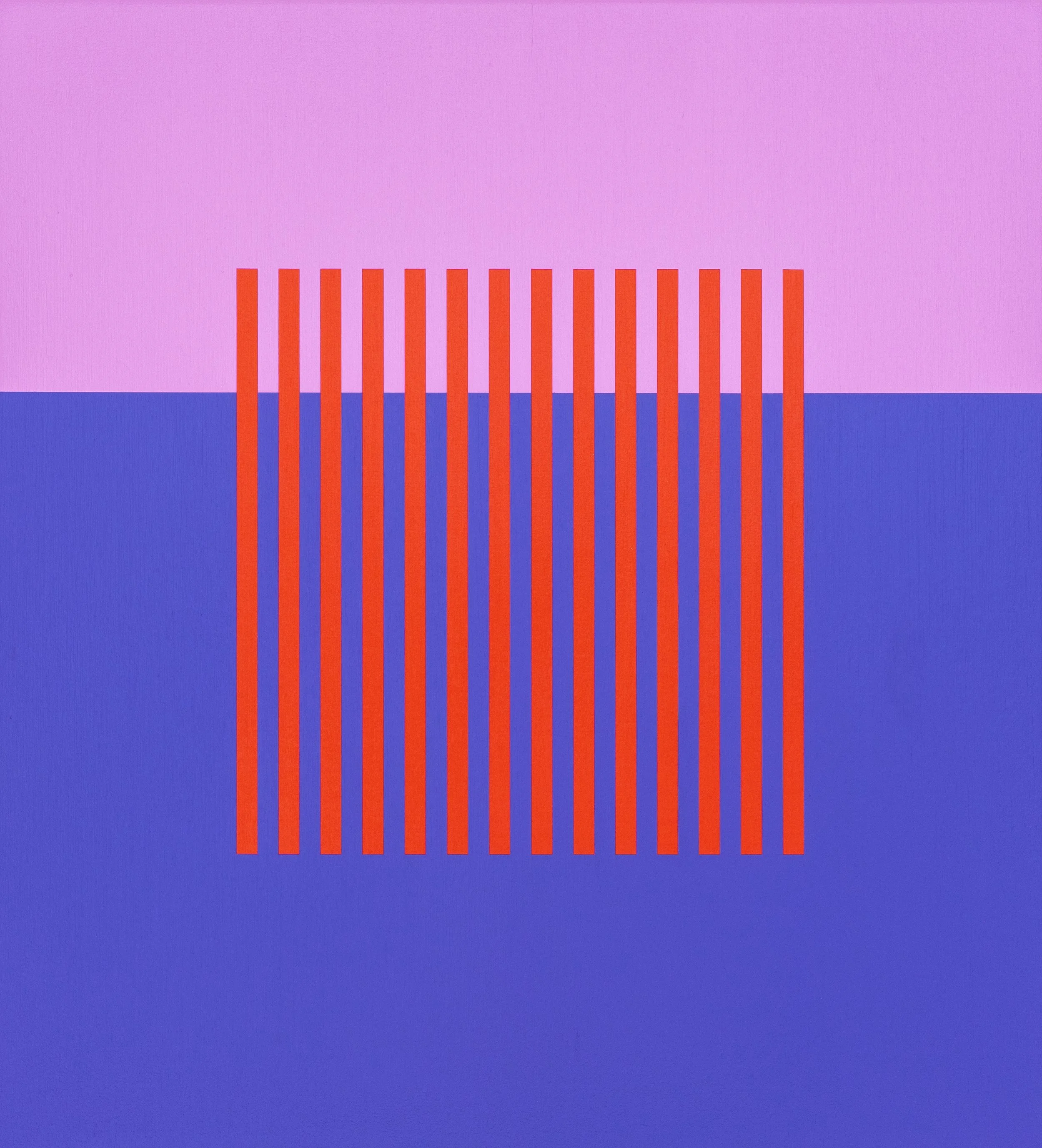
Peter Brook, Razzmic Cinnabar, 56 x 51cm, Acrylic on Linen, 2026, SOLD
In Razzmic Cinnabar, Brook connects the work to digital algorithms and predictive systems that influence contemporary Western social and economic life. This changes the way I understand its visual order. What first appears calm and balanced begins to feel slightly controlling. The pattern is attractive, yet it also recalls the invisible systems that organise our cities, anticipate our behaviour and increasingly shape the choices we make. The painting therefore sits somewhere between visual pleasure and unease.
What fascinates me about these two works is the tension between order and change. Their repeated lines and balanced structures suggest control, but colour creates movement, emotion and uncertainty. Brook’s paintings reward slow looking because their effects cannot be understood immediately. As our eyes adjust to the contrasts, certain colours advance while others recede, and the relationships between the different sections continue to shift.
Like light passing through a prism, Brook’s paintings show how a small shift can reveal an entirely different reality. They remind us that looking is never neutral. What we see is continually shaped by colour, context and the systems physical or digital, that surround us.
28 August 2026
Written by Xin Ji