
excursion | White Rabbit gallery
October 5 2026
Written by Zic Liu
Last month, we visited White Rabbit Gallery to see Black Myth. The exhibition takes its name and inspiration from the hugely popular 2024 video game Black Myth: Wukong, which retells the story of the classic Chinese novel Journey to the West. Starting from this famous journey, the exhibition expands the idea of a ‘journey’ into something much broader. Many of the works draw on traditional Chinese culture, mythology, literature and landscape imagery, and reorganise these familiar elements through contemporary art. Among the works in the exhibition, four especially stood out to me.
One of the first large-scale installations we saw when entering the gallery was Zhu Jinshi’s The Ship of Time (2018), which was almost impossible to miss. Made from thousands of sheets of Xuan paper, bamboo and cotton thread, the work forms a huge cylindrical structure that visitors can actually walk through. For me, the most interesting part was not looking at it from a distance, but the experience of stepping inside. Light passes through layers of translucent paper and becomes much softer, making the rest of the gallery feel temporarily separated from the space inside.
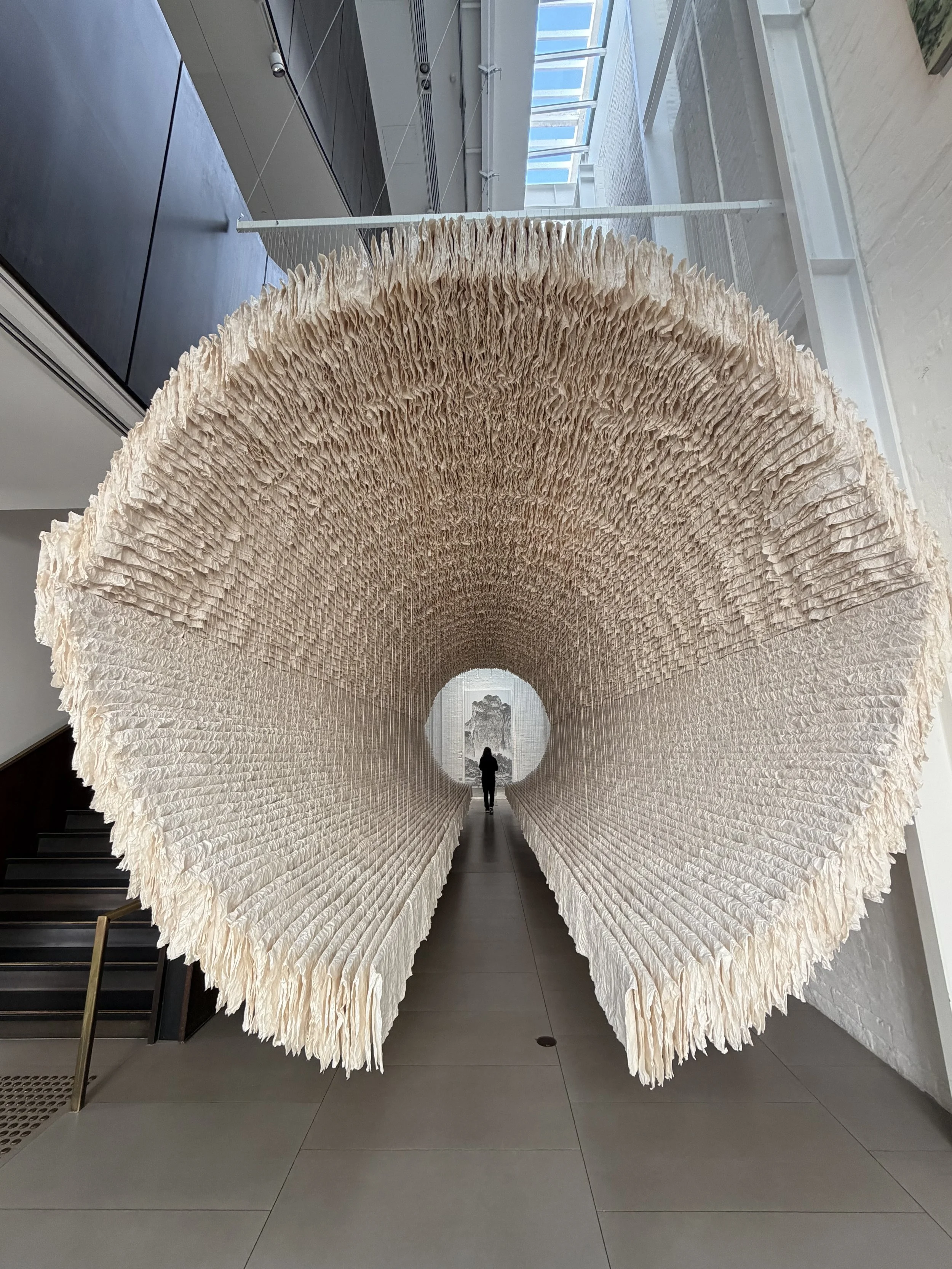
Zhu Jinshi 朱金石, The Ship of Time, 2018, Xuan paper, bamboo, cotton thread, 350 × 350 × 1500 cm.
Xuan paper and bamboo are both very familiar materials in traditional Chinese culture, but here they directly create a space that can be physically experienced. The curved bamboo structure also reminded me of moon gates and corridors in traditional Chinese gardens, where the view is constantly framed, hidden and revealed again as you move through the space. Although the installation is monumental in scale, the thinness and transparency of the paper make it feel surprisingly quiet and light. This contrast between something so large and something so delicate was what I liked most about the work. Even simply walking from one end of the structure to the other felt like completing a short journey, temporarily separated from the outside world.
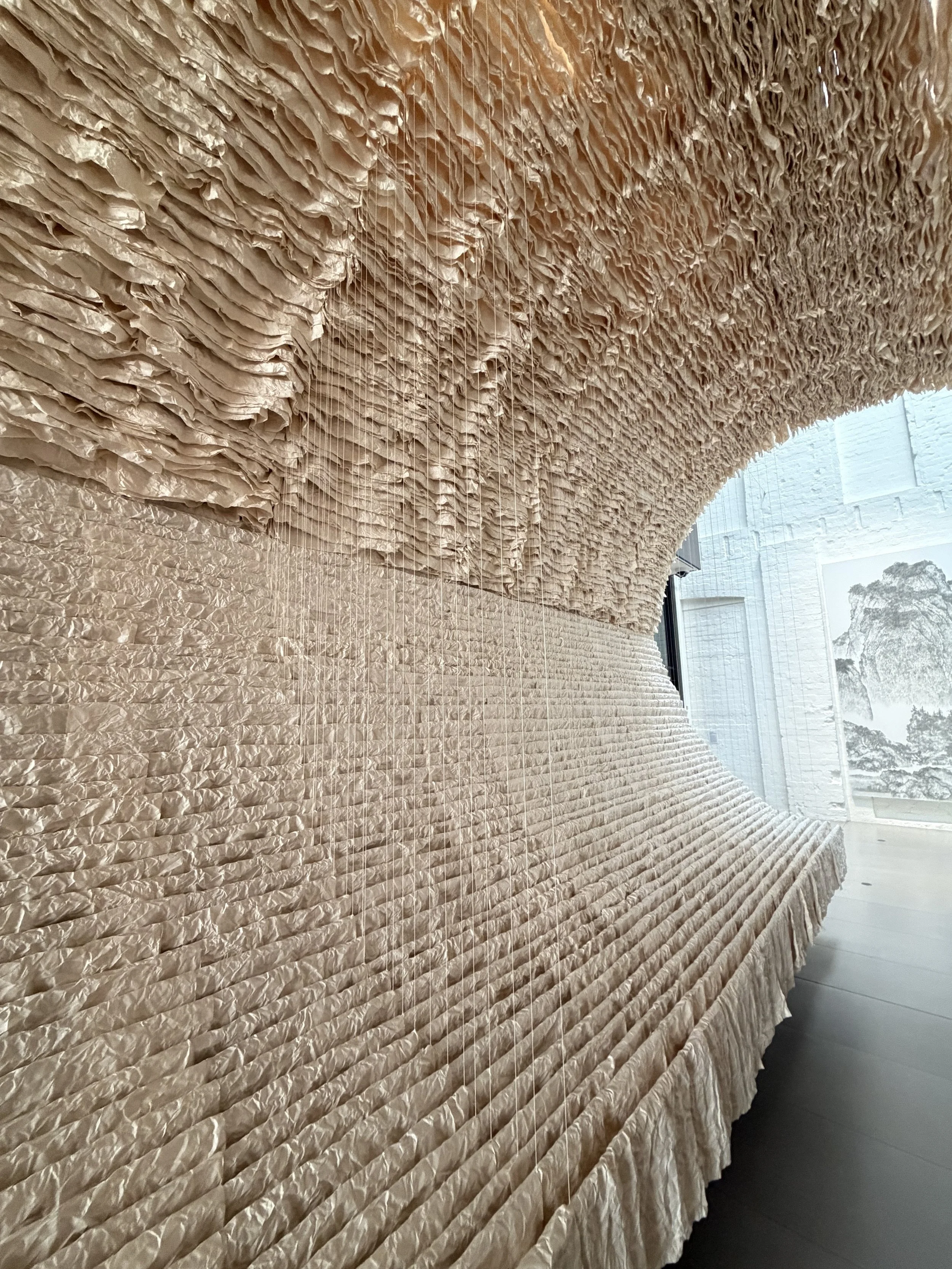
Zhu Jinshi 朱金石, The Ship of Time, 2018, Xuan paper, bamboo, cotton thread, 350 × 350 × 1500 cm.
Sun Xun’s Thirty-One Metre Long Scroll Painting of Jing Bang (2013–15) creates a completely different visual experience. The nearly thirty-metre-long ink painting stretches across the space, with mountains, dragons and a whale emerging from the sea to create a world that feels both familiar and strange.
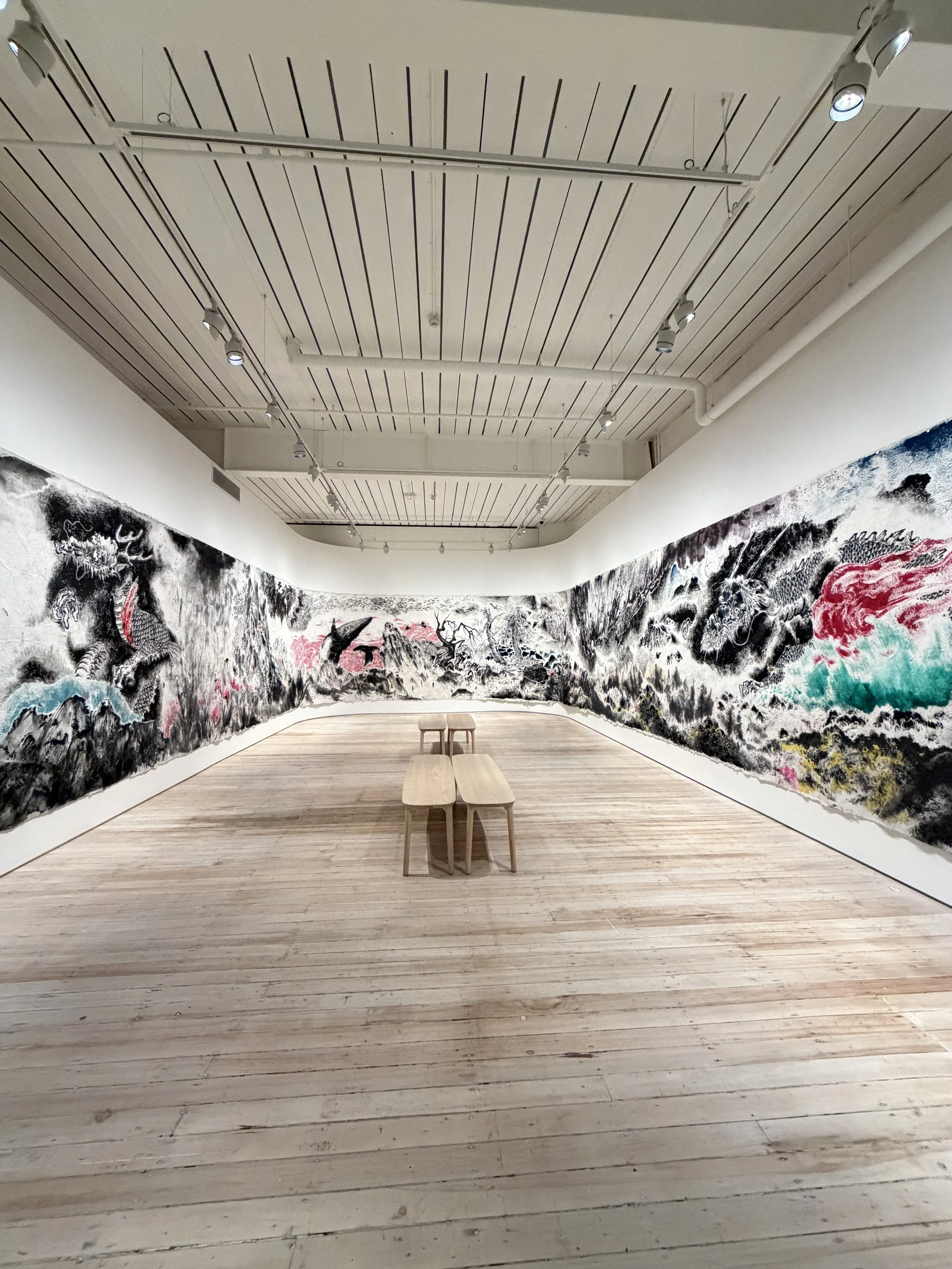
Sun Xun 孙逊, Thirty-One Metre Long Scroll Painting of Jing Bang, 2013–15, ink on handmade paper, 250 × 2962 cm.
At first glance, the work immediately brings traditional Chinese landscape painting to mind. The ink, handmade paper, mountains and mythical creatures all come from a familiar visual language, but the enormous scale changes the way we experience a traditional scroll. Handscrolls are usually viewed gradually, section by section. Here, however, the painting almost takes over your entire field of vision. You have to move alongside it to slowly discover the imagined world within it. For me, this combination of a traditional form with a contemporary scale is what makes the work so interesting. It looks as though it comes from the past, while at the same time clearly belonging to a newly imagined world.
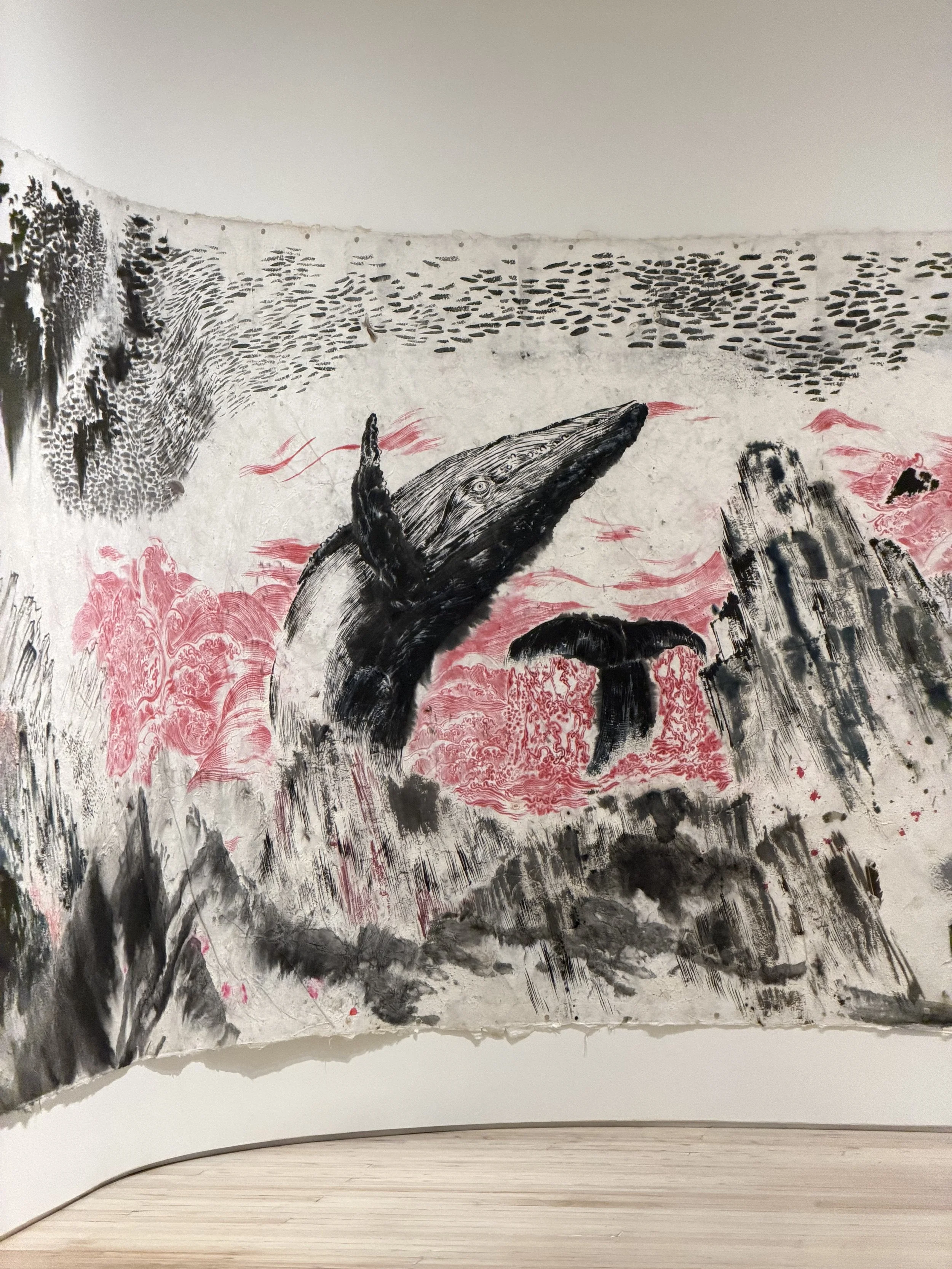
Sun Xun 孙逊, Thirty-One Metre Long Scroll Painting of Jing Bang, 2013–15, ink on handmade paper, 250 × 2962 cm.
This also connects naturally to the idea of the ‘journey’ in Black Myth. Looking at the work becomes a journey in itself. You cannot stand in one place and see the whole painting, you have to keep moving along with the scroll.
Walking down from the third floor to the second floor, another work immediately caught my attention. Hanging on the wall opposite the staircase were He Sen’s diptych Journey to the West — Divine Eagle and Journey to the West — Rebellious Birds (2011). An eagle flies above while two smaller birds sit on the branches of a loosely painted tree. The works reference Journey to the West, He Sen sees Sun Wukong as an image of rebellion, and takes small details from 1950s illustrations of Journey to the West and enlarges them into large-scale paintings.
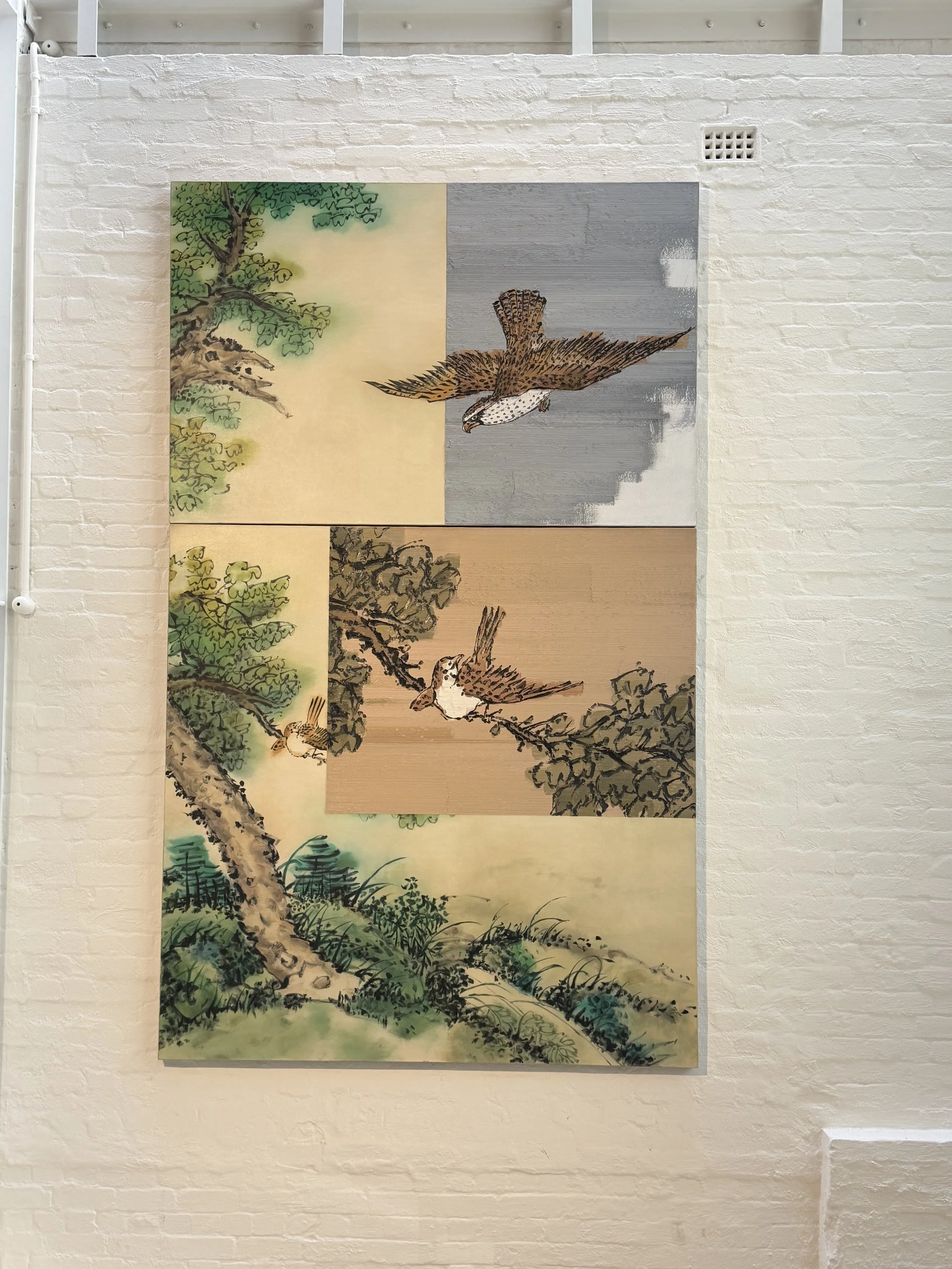
He Sen 何森, Journey to the West — Divine Eagle and Journey to the West — Rebellious Birds, 2011, oil on canvas, 130 × 200 cm and 200 × 200 cm.
I really like this approach because instead of directly recreating the familiar image of Sun Wukong, He Sen focuses on small moments from the story that could easily be overlooked. By enlarging these details into large oil paintings, we are able to see how these older images can be selected, reinterpreted and understood in a completely different way.
The final work that made me stop for quite a while was Yang Shen’s Step Wait (2024). Compared with the monumental scale of some of the other works, this painting is relatively small, but there is something strange and intriguing about its narrative. A tiger has entered an explorer’s camp, while the explorer has already fled in panic, leaving behind records, a hat and a helmet—objects associated with the so-called “civilised world”. The tiger, however, does not appear aggressive at all. With its back facing us, it calmly looks into the distance. Viewing the painting from beyond the two archways in the gallery made the scene even more interesting, almost as if we were quietly looking into another world from a distance.
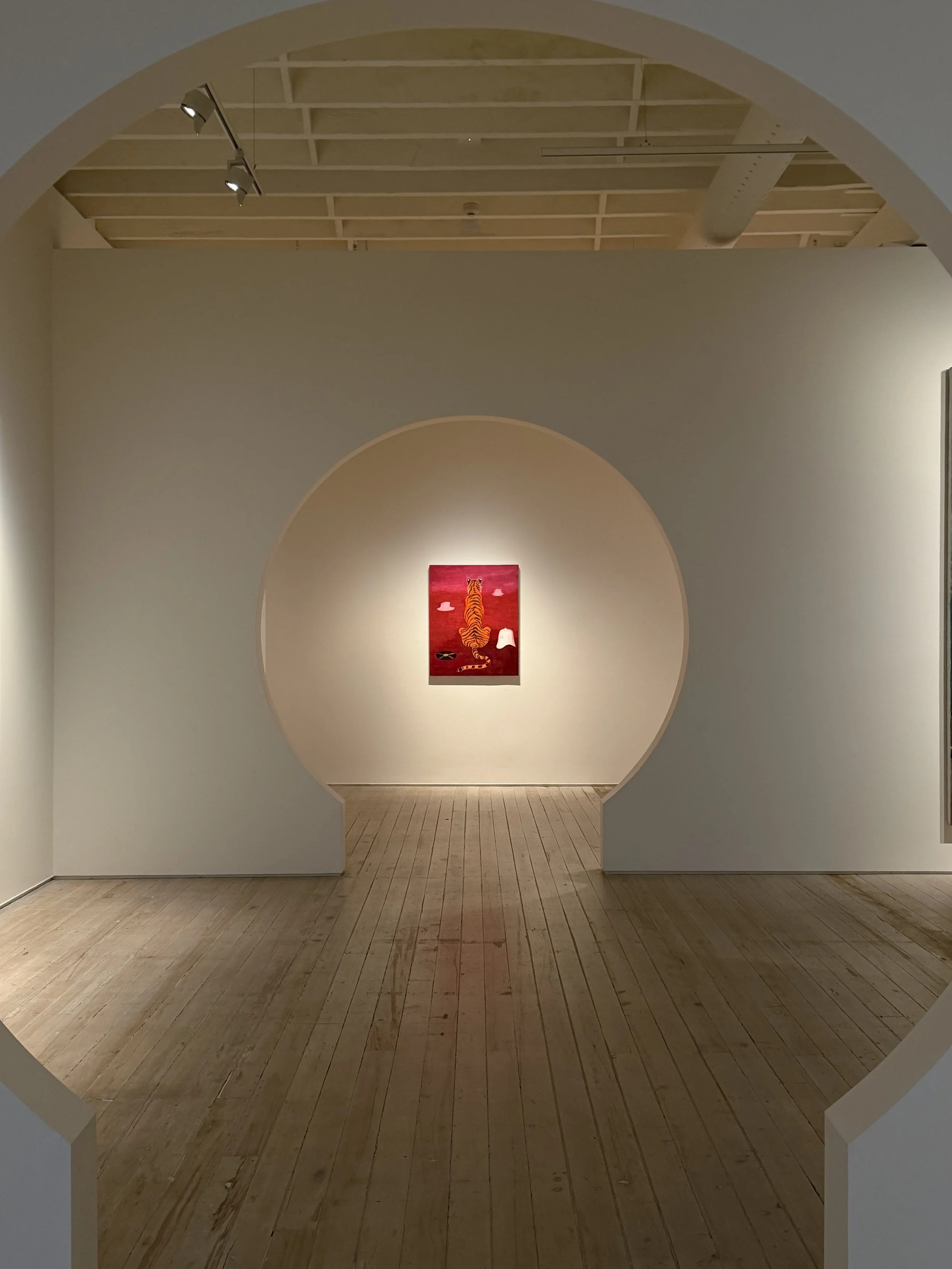
Yang Shen 杨深, Step Wait, 2024, oil on canvas, 100 × 80 cm.
Although these four works are very different, they all begin with things that are familiar within Chinese culture. Xuan paper, bamboo, landscape painting, Journey to the West, mythology, and the relationship between humans and nature. At the same time, none of them simply repeat these traditional symbols. Through changes in scale, material, space and storytelling, they make familiar things feel slightly unfamiliar again.
This was also what I found most interesting about Black Myth. The exhibition begins with Black Myth: Wukong and Journey to the West, but in the end, it asks us to think about what a ‘journey’ can mean.
30 Balfour Street (Corner of Wellington St and Balfour St), Chippendale NSW 2008
Wednesday–Sunday 10am–5pm
White Rabbit Gallery opened in Sydney in 2009 to showcase Judith Neilson’s collection of 21st-century Chinese contemporary art. Inspired by her visits to Beijing in the late 1990s, Neilson has built a collection of more than 3,000 works by over 800 artists from China and Taiwan. Housed in a former Rolls-Royce service depot, the gallery presents two new exhibitions each year. It is privately funded by Neilson and offers free admission.
