
PRISM: Searching for a Body in Xinzhi(Doris) Li’s Vessel searching
7 August 2026
Written by Zic Liu
A prism separates what seems to be a single beam of light into different colours. In Xinzhi(Doris) Li’s Vessel Searching, the body goes through a similar process. It no longer appears as a complete and stable form. Instead, it is broken into fragments that resemble organs, limbs and traces of a face, mixed with flowing and overlapping colours. Bright yellow, red, blue and purple move through these body fragments, making the image seem to be forming and dissolving at the same time.
This sense of uncertainty is an important part of the work. The body is made up of many different fragments rather than one complete form. These fragments come together, overlap and are then broken apart again by the surrounding colours. Bright yellow and orange seem to glow from inside the body, while deep purple, dark red and grey add a sense of weight. Pale blue lines and liquid-like marks move through different areas of the painting. They connect parts that would otherwise feel separate. Because of this, the whole image feels as if it is in motion. It also seems to be searching for a way to bring these fragments together.
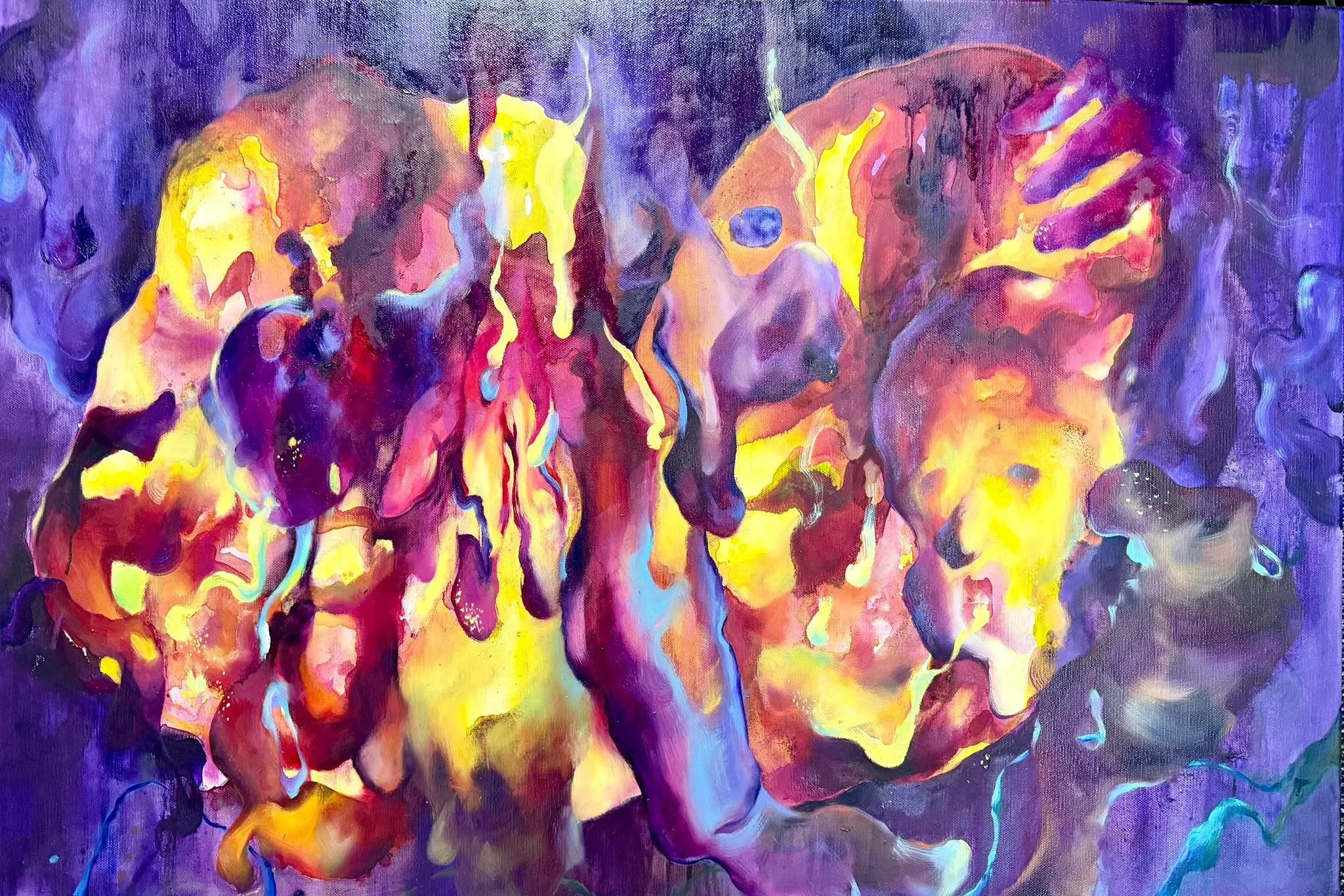
XinZhi(Doris) Li, Vessel Searching, 60 × 90cm, Acrylic and oil on canvas, 2026, $2800
The title, Vessel Searching, adds another layer to this feeling. A “vessel” can be understood as a container. It can also suggest the body itself, as a space that holds consciousness, emotion and the soul. In this work, however, the vessel does not feel complete. Different parts of the body are still taking shape. It feels as if something is searching for a form that can hold it, or a place where it can finally belong.
Vessel Searching does not present the viewer with a complete figure. Instead, it stays in an unfinished state. This makes the body feel less like a fixed outer shell and more like a space that is always changing. In the context of PRISM, refraction can also be understood as something that happens between the body and the self. Just as white light reveals different colours when it passes through a prism, Li breaks the body into fragments and feelings. Through this process, a self that first appears singular becomes more complex. The work does not try to put everything back together into one clear answer. Instead, it allows the body to remain in a process of searching and becoming.
