
Prism: Keith Ross and the Extraordinary Ordinary
31 July 2026
Written by Xin Ji
When I first encountered Keith Ross’s work, I was drawn to the strangeness and childlike quality of his figures. Their bodies are distorted, their expressions exaggerated, and their colours vivid but deliberately detached from reality.
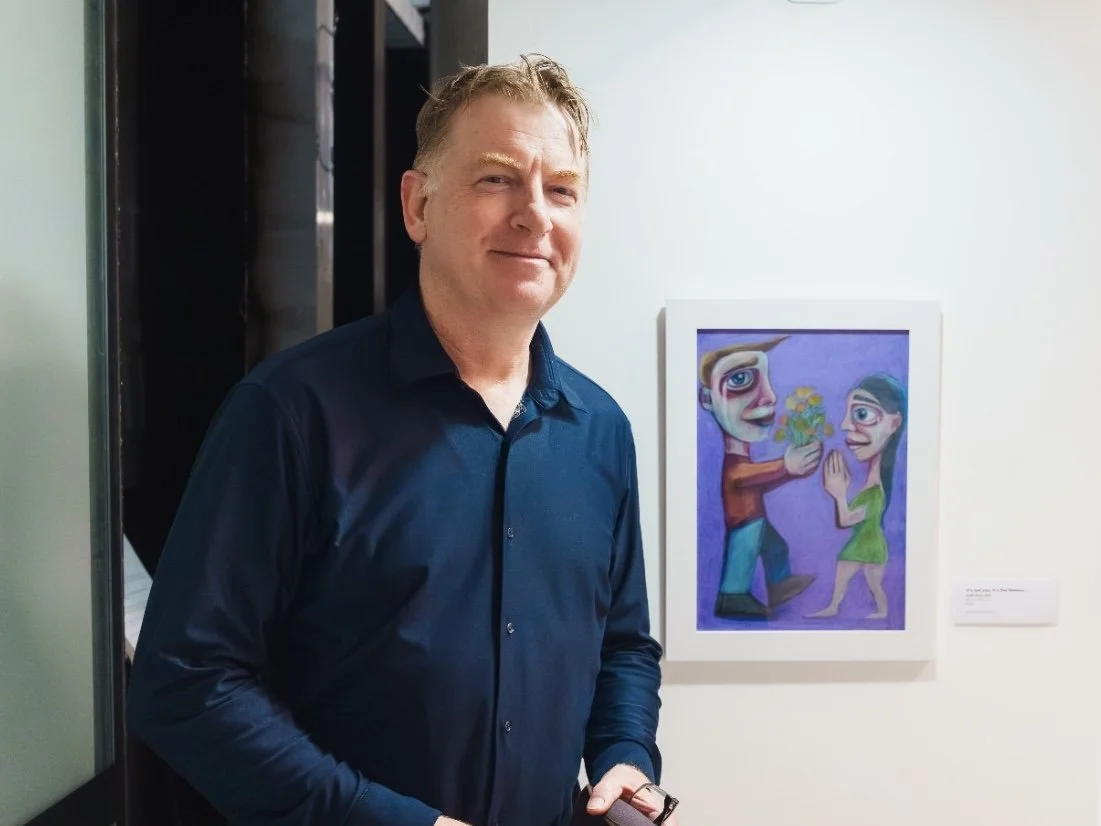
Keith Ross with his painting It’s not you, It’s the flowers…. at the Transitions exhibition at ROMULUS.
They reminded me slightly of Henri Rousseau, not only because of the naïve quality of their imagery, but also because of the unusual place art has occupied in both artists’ lives. Rousseau worked as a customs officer and painted largely in his spare time. Ross likewise moves between different roles: artist, volunteer firefighter, and Army reservist. Yet the worlds they create are very different. Rousseau turned away from ordinary life towards imagined jungles and exotic scenes, while Ross celebrates the everyday mundane.
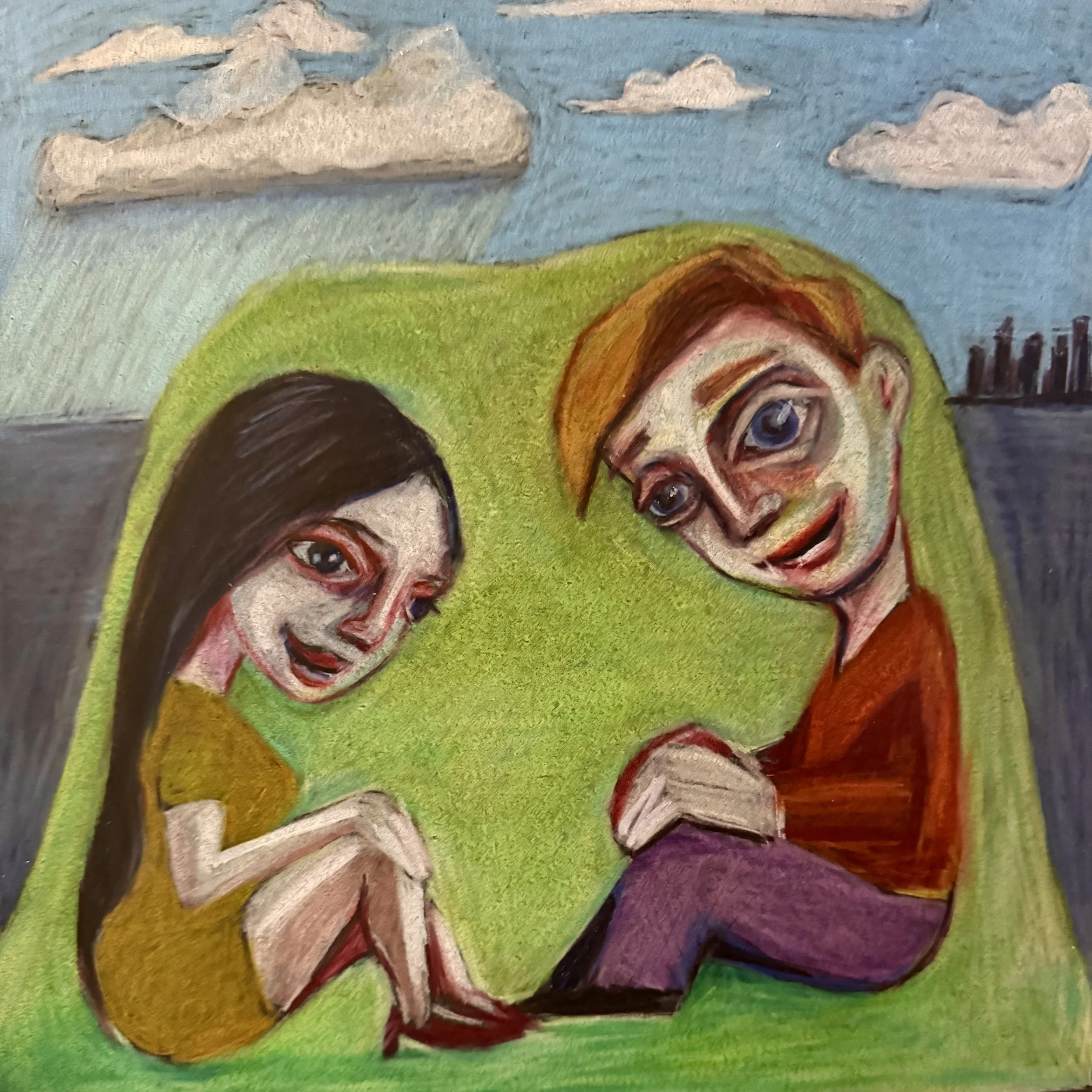
Keith Ross, No Bluff on the Bluff, 2025. Pencil on paper, 32.5 × 32.5 cm.
In No Bluff on the Bluff, two figures sit together on a grassy hill, with water and the distant city behind them. Their bodies lean towards one another, but their expressions are difficult to read. They could be friends, partners, or simply two people sharing a quiet afternoon. There is intimacy between them, but also a slight awkwardness that keeps the scene from becoming sentimental.
What interests me most is the spatial composition. The city remains visible, but it has been pushed to the edge of their experience. Surrounded by the green landscape, the two figures seem to sit inside a bubble, protected for a moment from noise, routine, and expectation. They do not need to perform for anyone; they can simply relax together in a private moment within an open landscape.
The title adds a playful double meaning. A ‘bluff’ is the hill on which they sit, but to ‘bluff’ also means to pretend or conceal what one feels. Their slight shyness and awkwardness make the moment feel more honest. Intimacy is not always elegant. Sometimes it is simply sitting beside someone without needing to fill the silence.
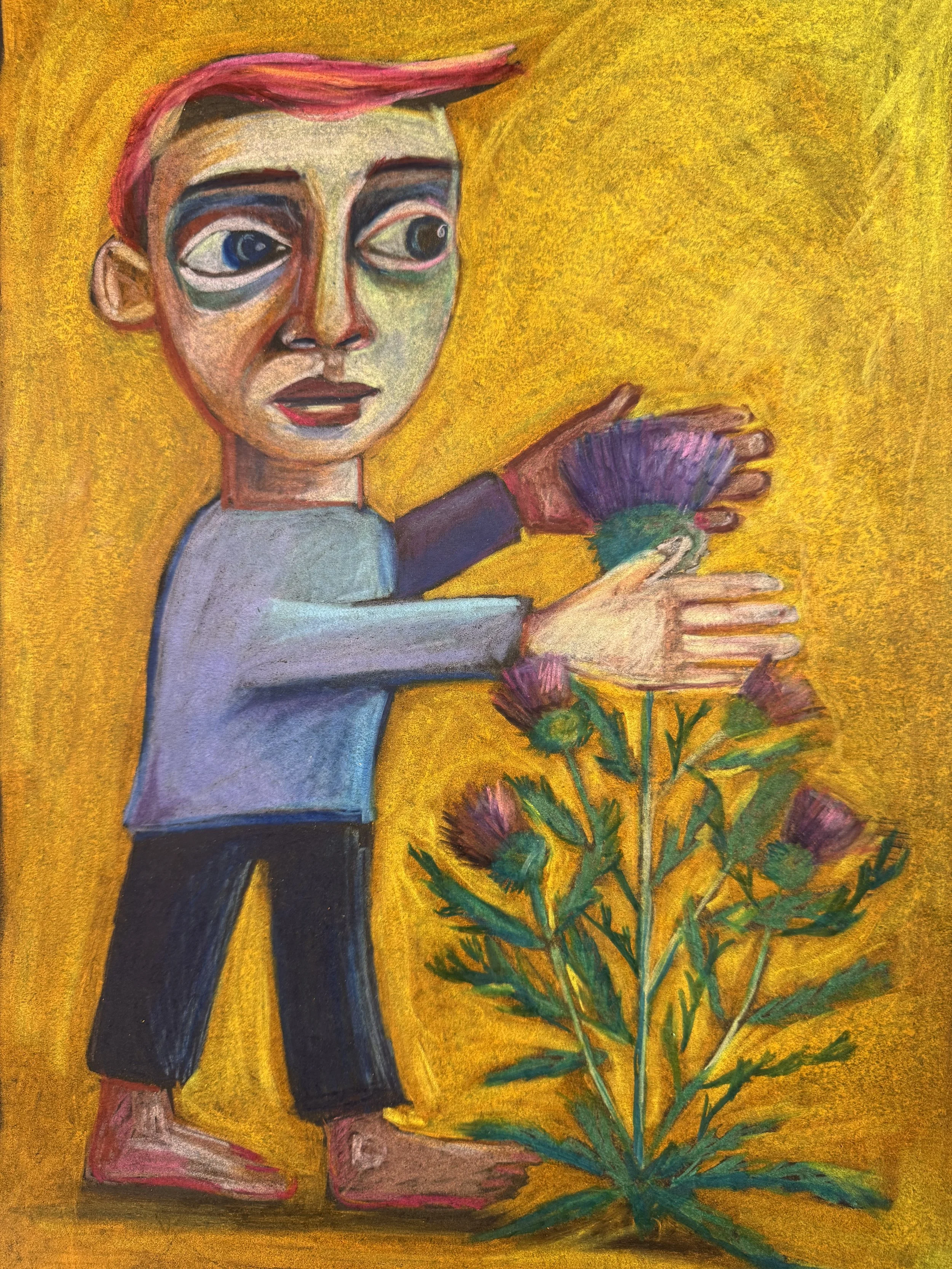
Keith Ross, The Pain of Beauty, 2026. Pencil on paper, 30 × 42 cm.
The Pain of Beauty feels more solitary and tense. The figure reaches towards a Scottish thistle, a spiky plant that grows abundantly around Ross’s home in north-eastern Victoria. The purple flower appears vivid against the bright yellow background. The enlarged hands and uneasy expression suggest hesitation. The figure seems to know that touching the plant may hurt, yet reaches out anyway.
This reminded me of picking roses as a child. I knew they had thorns and that I had been scratched before, but I still wanted to pick something beautiful. Perhaps this is a human instinct: we are drawn towards beauty even when we understand its risks. We heal, forget the pain, and reach again.
The work also makes me think about cultural memory and transplantation. A plant moved into unfamiliar soil can continue growing, but it must adapt to new conditions. People who relocate experience something similar. We build new lives while carrying habits and attachments from elsewhere. Sometimes the body recognises something familiar before the mind can explain it. That recognition can be comforting, but it can also remind us of distance.
A prism reveals many colours within a seemingly simple beam of light. Similarly, Ross reveals several feelings within ordinary moments. No Bluff on the Bluff holds intimacy, honesty, awkwardness, and relief, while The Pain of Beauty brings together attraction, memory, displacement, and discomfort. By paying attention to these small encounters, Ross shows that the ordinary is never emotionally simple.